

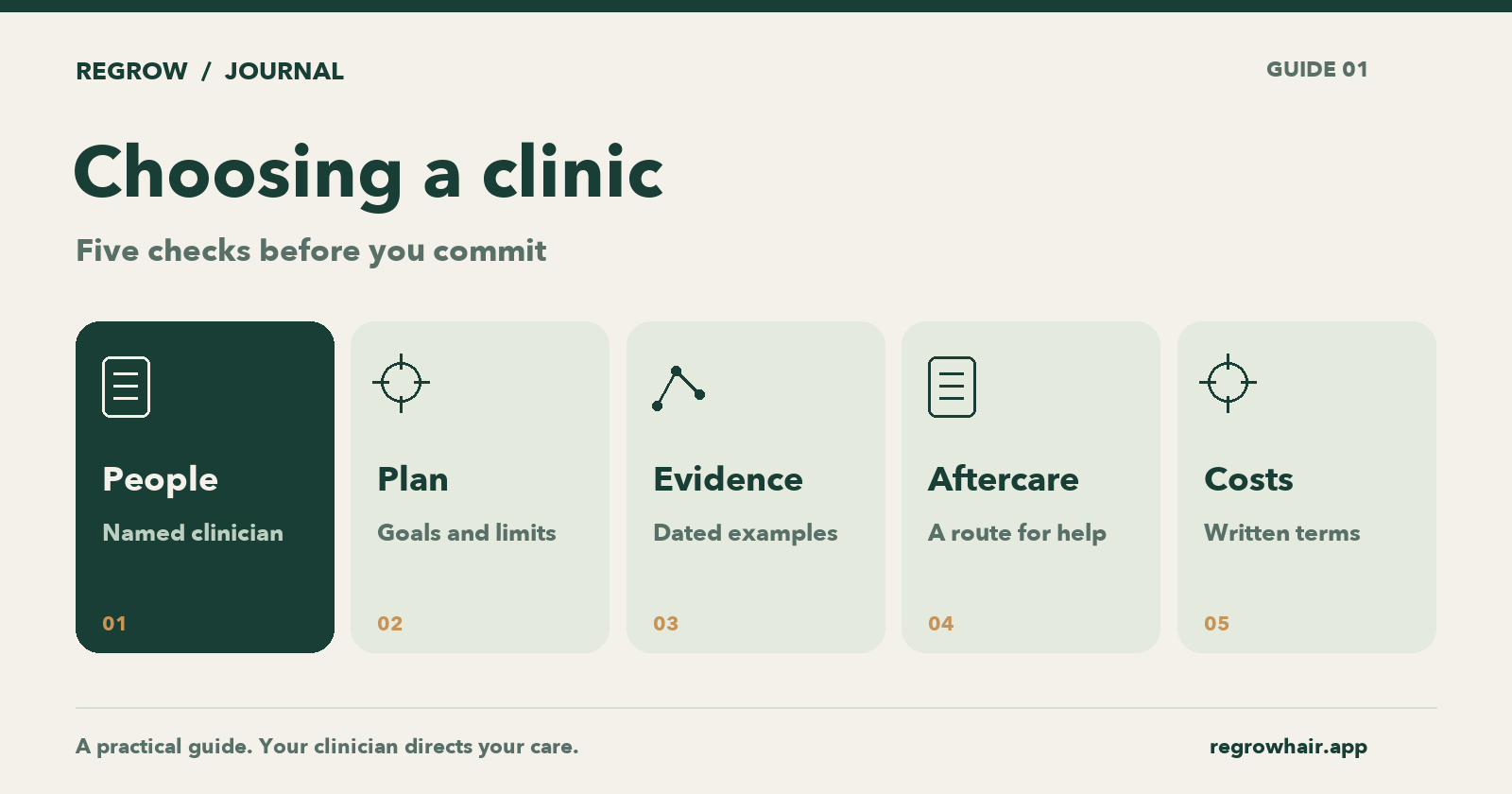
Original Regrow editorial diagram. All meaningful guidance is also available in the article text.
A convincing before-and-after photo is a reason to ask questions. It is not enough information to book surgery. The best hair transplant clinic for you should be able to explain who will operate, why the proposed plan suits you, what it cannot achieve, and who will help after you go home.
This guide gives you a way to compare answers. It does not rank clinics, sell referrals, or award a “best clinic” badge.
Start with a named surgeon, not a package
Ask for the treating surgeon’s full name before you pay a deposit. Check that name with the medical regulator in the country where the operation will happen. A clinic’s social-media following is a different kind of information from a clinician’s registration.
The NHS recommends meeting the person who will perform a cosmetic procedure and checking their training, experience and insurance. Its advice is UK-specific where it names regulators; elsewhere, use the relevant local medical authority. Read the NHS guide to choosing a practitioner.
In your notes, make three separate entries: clinic name, surgeon name, registration checked. Leaving the third box blank is more honest than treating a logo on a website as verification.
Get a plan you can explain back
A consultation should answer more than “How many grafts?” Ask the surgeon to explain the diagnosis, the area being treated and the reason for the proposed approach. The American Academy of Dermatology notes that transplant suitability depends on an examination, including whether enough suitable donor hair is available. AAD: hair transplant candidacy.
Try summarising the proposal in your own words: “The priority is this area; this part may remain thin; these are the alternatives.” If you cannot complete that sentence, request clarification before comparing prices.
Use this five-part comparison sheet
For each clinic, record Answered, Needs clarification, or Not provided. This is a worksheet, not a clinical safety score; several reassuring answers cannot cancel out an important unanswered question.
People: Who performs each stage, and who is responsible for my care?
Plan: What are the goals, limitations and alternatives for my situation?
Evidence: Can we review dated examples relevant to my starting point, including the donor area?
Aftercare: Who answers concerns, through which channel, and what happens outside opening hours?
Costs: What is included, what could cost extra, and what are the cancellation terms?
The ISHRS also encourages patients to ask about the qualifications and responsibilities of everyone involved in surgery. Its questions provide a useful starting point for that conversation. ISHRS consultation questions.
Keep the clinic’s actual answer beside each question. “They seemed confident” will be difficult to compare a week later; “written aftercare contact provided” is specific.
Read the gallery as evidence, not a promise
Ask whether the examples show the same person, when each photograph was taken, and whether lighting, angle, hair length or styling changed. Ask what you are seeing in the donor area as well as the hairline. A good-looking example does not establish what your own result will be.
If you are shown a result unlike your starting point, ask why it is relevant. You do not need to accuse anyone of misleading you to request a more useful comparison.
Give yourself an exit before paying
Take the written proposal away. Read the consent information and payment terms when you are not in a sales conversation. The NHS advises caution about time-limited offers and decisions made under pressure. NHS: before a cosmetic procedure.
An unanswered question is a reason to pause. Choosing another consultation, postponing surgery or deciding against it are legitimate outcomes.
Keep the decision record in one place
Make a folder for each clinic: proposal, quote, questions and answers. After you choose, keep the final instructions separate from older proposals so you do not accidentally follow the wrong document.
Download Regrow to organise your hair-transplant journey and recovery record. Its core patient features are free; optional Secure Backup terms are shown in the app. For an overview of what follows surgery, see the recovery timeline guide.
Published by Regrow, the app maker. AI-assisted research and writing; not a clinical review or a clinic endorsement. General education only. Your treating clinician’s advice takes priority.
- Planning
- Hair transplant
Regrow provides general education and self-tracking. It is not a medical device and does not provide diagnosis, treatment or medical advice. This article has not been reviewed by a clinician. Your clinic's instructions always come first.