


Original Regrow editorial diagram. All meaningful guidance is also available in the article text.
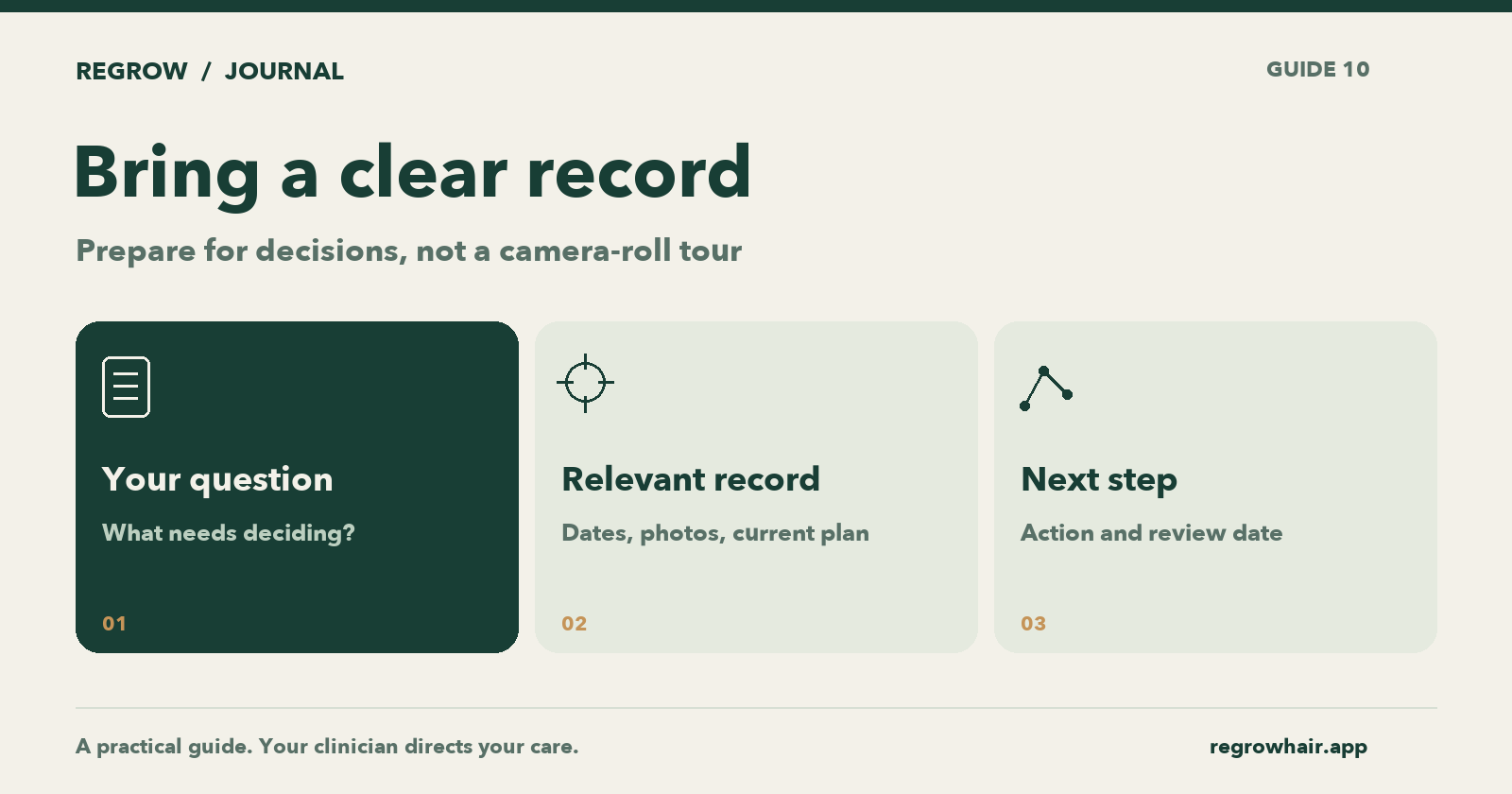
A follow-up is easier to use when you arrive with a clear question, relevant photographs and the current care plan. A camera roll containing hundreds of almost identical images can obscure the one change you wanted to discuss.
This guide helps you prepare a concise appointment record. It does not tell you whether a transplant has succeeded or when you should have another procedure.
Start with the decision you need help making
Write one sentence before collecting files: “At this appointment I want to understand ____.” It might concern an observation, a restriction, the next review or the longer-term plan.
If you have several questions, choose the most important three and keep the rest underneath. This helps you use the appointment without forgetting the issue that prompted it.
Build a one-page summary
Use five headings:
Procedure: date, clinic and any treatment summary you were given.
Since the last review: observations and their dates.
Current plan: the instructions you are following and questions about them.
Photos: a small set with clear dates and matching views where possible.
Decisions needed: your prioritised questions.
Record observations rather than conclusions. “I noticed this area looked different in these two images” is easier to examine than “my grafts have failed.” If there is uncertainty about a date or instruction, identify it.
Choose photographs for context
Include the baseline or earlier image relevant to the question, the latest comparable image, and any additional view the clinic requests. Label differences in hair length, styling or lighting. Retain the originals if the clinician needs them.
Do not remove every ordinary-looking image and present only the most alarming one. Equally, do not select only flattering pictures because you feel embarrassed about your concern. The appointment is for an accurate discussion.
Ask the clinic how it wants files sent and whether it needs them before the appointment. Avoid posting sensitive images publicly merely to obtain a quick opinion.
Ask what the current stage can and cannot tell you
The AAD explains that visible results develop over months and that some people take longer than others. An early checkpoint should not be treated as a final verdict. Hair loss can also continue outside the transplanted area. AAD: results and longer-term care.
Useful questions include: “What can you assess today?”, “What remains too early to judge?” and “What would make you want to review me sooner?” Ask the clinician to explain the reasoning, not just attach a percentage to progress.
Leave with a written next step
Before the appointment ends, confirm what stays the same, what changes, and when the next review should happen. If a treatment is prescribed or adjusted, ask the prescribing clinician to explain how to use it and where to get help with questions. Do not infer medication changes from a general article.
Write the next action as something concrete: book a review, send a requested photograph, or follow the updated instruction. “Keep monitoring” is worth clarifying if you do not know what the clinician wants you to monitor.
Keep concerns out of the waiting queue when they are urgent
A planned appointment is not a reason to delay appropriate medical help for a new urgent problem. Use the clinic’s escalation instructions and local urgent or emergency services as needed.
For routine organisation, download Regrow. Its dated photo diary and recovery record can help you find the material you want to discuss. Interpretation and treatment decisions remain with your clinician.
Published by Regrow. AI-assisted research and writing; not clinically reviewed. The worksheet supports appointment preparation and does not replace medical assessment.
- Recovery
- Hair transplant
Regrow provides general education and self-tracking. It is not a medical device and does not provide diagnosis, treatment or medical advice. This article has not been reviewed by a clinician. Your clinic's instructions always come first.