


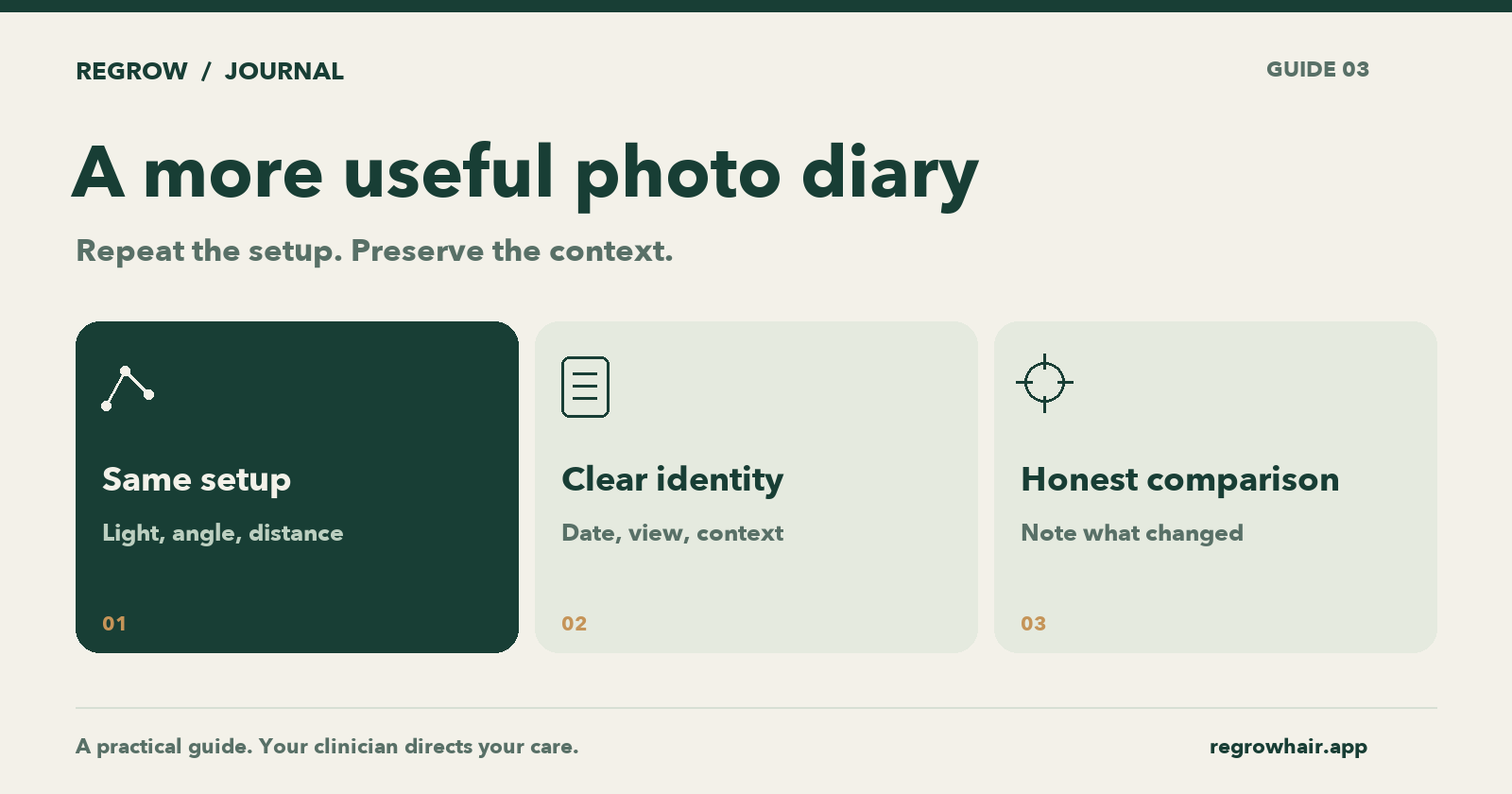
Original Regrow editorial diagram. All meaningful guidance is also available in the article text.
Two photographs can make the same head of hair look surprisingly different. Before interpreting a comparison as progress or a setback, check what changed in the photograph itself: angle, distance, lighting, styling and date.
A useful photo diary is a repeatable record. It is not a home test of graft survival, density or healing. The method below helps you organise that record without manufacturing a dramatic before-and-after.
Choose a setup you can repeat
Pick a location you can use again. Note where you stand, where the camera sits and which light is on. A small marker on the floor or a written note can save you from guessing next time.
The AAD’s clinical-photo guidance recommends clear focus, useful lighting, a plain background and disabled filters. It also suggests help or a camera timer for hard-to-reach areas. These are photography principles, not a transplant aftercare protocol. AAD: taking pictures for your dermatologist.
Do not handle, position or expose a newly treated area in a way your clinic has told you to avoid just to get a better photograph. Ask someone to help if your permitted movement makes an angle difficult.
Give every image an identity
A workable record needs three things: date, angle and context. “Day 30, front, dry hair, same room” is more useful than “progress 7.” Keep the original file as well as any copy used for comparison.
Regrow’s photo diary uses labelled views, including the front or hairline, crown, sides and donor area. You can use equivalent labels in an ordinary phone album. The important part is consistency, not a specific folder name.
If you add older photographs, use the date the picture was taken. The date you imported it is not the recovery date. If you cannot establish the original date, label that uncertainty rather than inventing a checkpoint.
Use a short comparison checklist
Before putting two photos side by side, ask:
Are they the same angle, or is one tilted to hide an area?
Is the camera similarly far away, with the same zoom setting?
Is the hair similarly styled and in a comparable wet or dry state?
Did a haircut, product or lighting change alter the appearance?
Are the dates correct, and have the originals been preserved?
When something differs, keep the image and add a note. An imperfect photograph can still document an event; it simply should not carry more meaning than it supports.
Separate a routine record from a clinical concern
Routine photos answer “What did this look like on this date?” A message to your clinic answers “What has changed, and what should I do?” Those are different jobs.
For a concern, include the location, when you noticed it, whether it is changing and the question you need answered. Ask the clinic which views and communication channel it wants. Taking more photos should never delay seeking help for an urgent problem.
Keep a record that is honest enough to share
Avoid beauty filters, artificial filling, altered hairlines and selective cropping that hides a relevant area. If you crop a copy for readability, retain the uncropped original. Do not relabel a picture to create a more impressive interval.
You also do not owe a public audience your recovery record. A photo can be valuable because it helps you talk to your clinician, even if nobody else sees it.
Download Regrow to keep recovery photos on their dates and compare matching views. The core app is free, with optional Secure Backup. Regrow documents change; interpretation of your recovery belongs with your treating clinician.
Published by Regrow. AI-assisted research and writing; not clinically reviewed. The accompanying diagram is an original photography checklist, not patient imagery.
- Photo diary
- Hair transplant
Regrow provides general education and self-tracking. It is not a medical device and does not provide diagnosis, treatment or medical advice. This article has not been reviewed by a clinician. Your clinic's instructions always come first.