


Original Regrow editorial diagram. All meaningful guidance is also available in the article text.
Seeing hair come away after a transplant can be unsettling. It is also easy to give a single photograph more meaning than it can support. A useful next step is to separate general recovery information from the question of what is happening on your own scalp.
The American Academy of Dermatology describes shedding of transplanted hair during the weeks after surgery, commonly within two to eight weeks. That general pattern cannot confirm that every instance of hair loss, discomfort or skin change is harmless. AAD: what to expect after a transplant.
A timeline gives context, not a diagnosis
Your operation date helps the clinic interpret your question. It does not let a forum, an app or an article determine graft survival. Do not count loose hairs or inspect something in the sink as a substitute for an assessment.
If you need an overview, our recovery timeline explains the broad stages. Use it to prepare questions, not to dismiss a symptom because a calendar says you are in a particular phase.
Make one clear note before sending ten messages
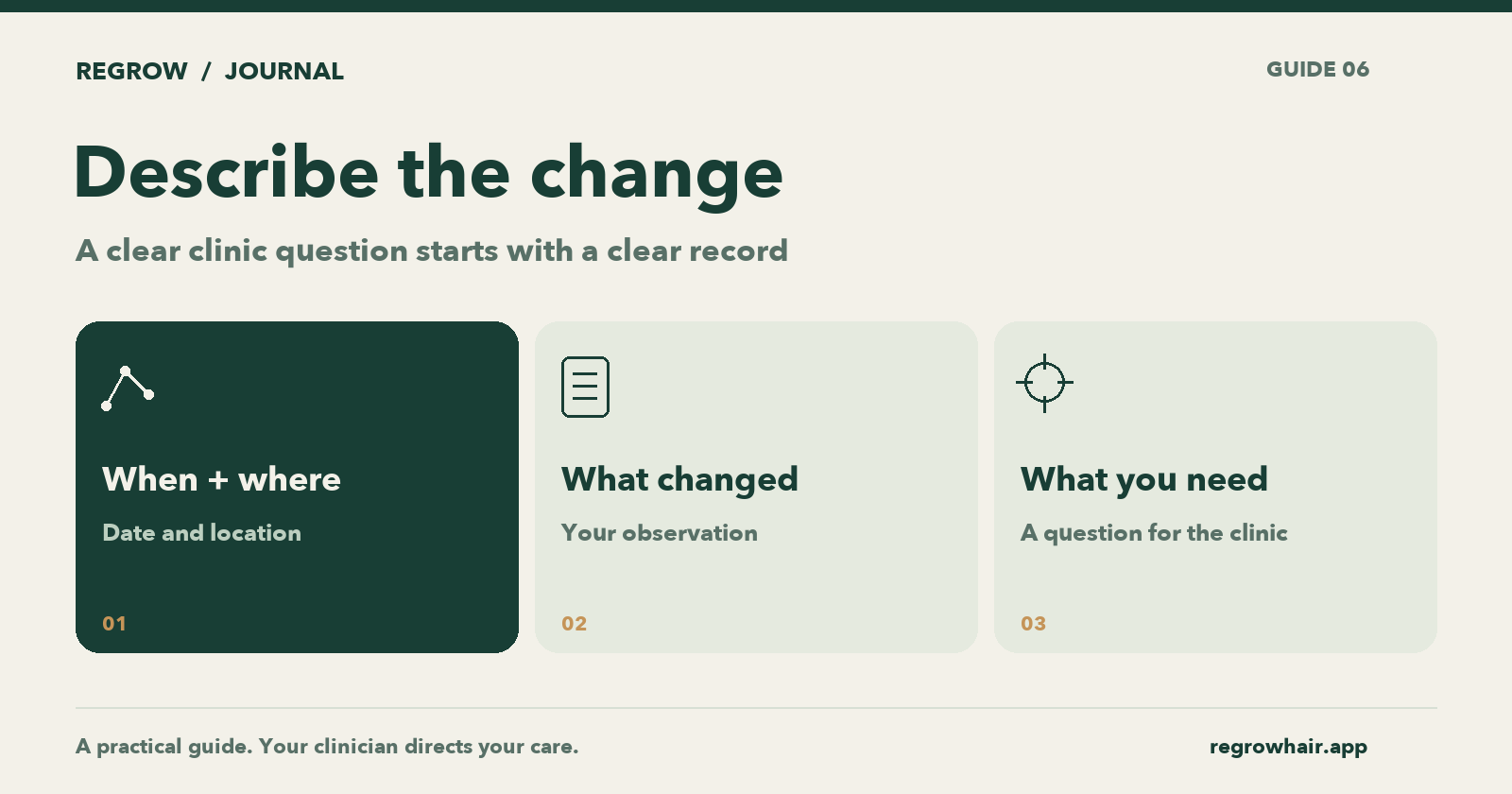
Record the observation in plain language:
When: operation date and when you first noticed the change.
Where: which area concerns you.
What: what you can see or feel, without diagnosing it.
Change: whether it is improving, worsening or unchanged.
Question: the decision you need help with now.
For example: “My procedure was on [date]. Since [time], I have noticed [observation] around [area]. It has [changed in this way]. I am following [the named instruction]. Do I need a review, and should I change anything?” This is a message template, not a fictional patient outcome.
Send pictures the clinic can use
Follow the clinic’s requested views and secure communication route. Include the relevant date and preserve the originals. Avoid sending a dramatic close-up with no indication of where it was taken; ask what additional context the clinician needs.
If an image is blurry, say so or retake it safely. If the appearance differs from the previous photo because your hair was wet, note that difference. The goal is to describe your concern accurately, not to prove that recovery is going well or badly.
Do not wait for a routine photo checkpoint if you are unwell
Hair transplantation can involve complications such as bleeding or infection. The NHS advises contacting the clinic promptly for severe pain or unexpected symptoms. NHS: hair transplant risks and getting help.
For a medical emergency, use local emergency services. An app message or a scheduled follow-up is not an emergency service. If you are unsure how urgently you need assessment, seek appropriate medical advice rather than waiting for this article’s checklist to be complete.
Keep the response with the original question
When the clinic replies, save its instructions and the date. If the reply changes your care plan, ask which earlier instruction it replaces. A scattered chat history becomes difficult to follow when two messages seem to disagree.
Avoid adding products, changing medication or testing the treated area because an online story sounded similar. Questions about your treatment belong with the prescribing or treating clinician.
Download Regrow to keep your recovery date, photos and clinic information together. Regrow can help organise the record; it cannot confirm whether your grafts are healthy.
Published by Regrow. AI-assisted research and writing; not clinically reviewed. General education only, not an assessment of your symptoms.
- Recovery
- Hair transplant
Regrow provides general education and self-tracking. It is not a medical device and does not provide diagnosis, treatment or medical advice. This article has not been reviewed by a clinician. Your clinic's instructions always come first.