


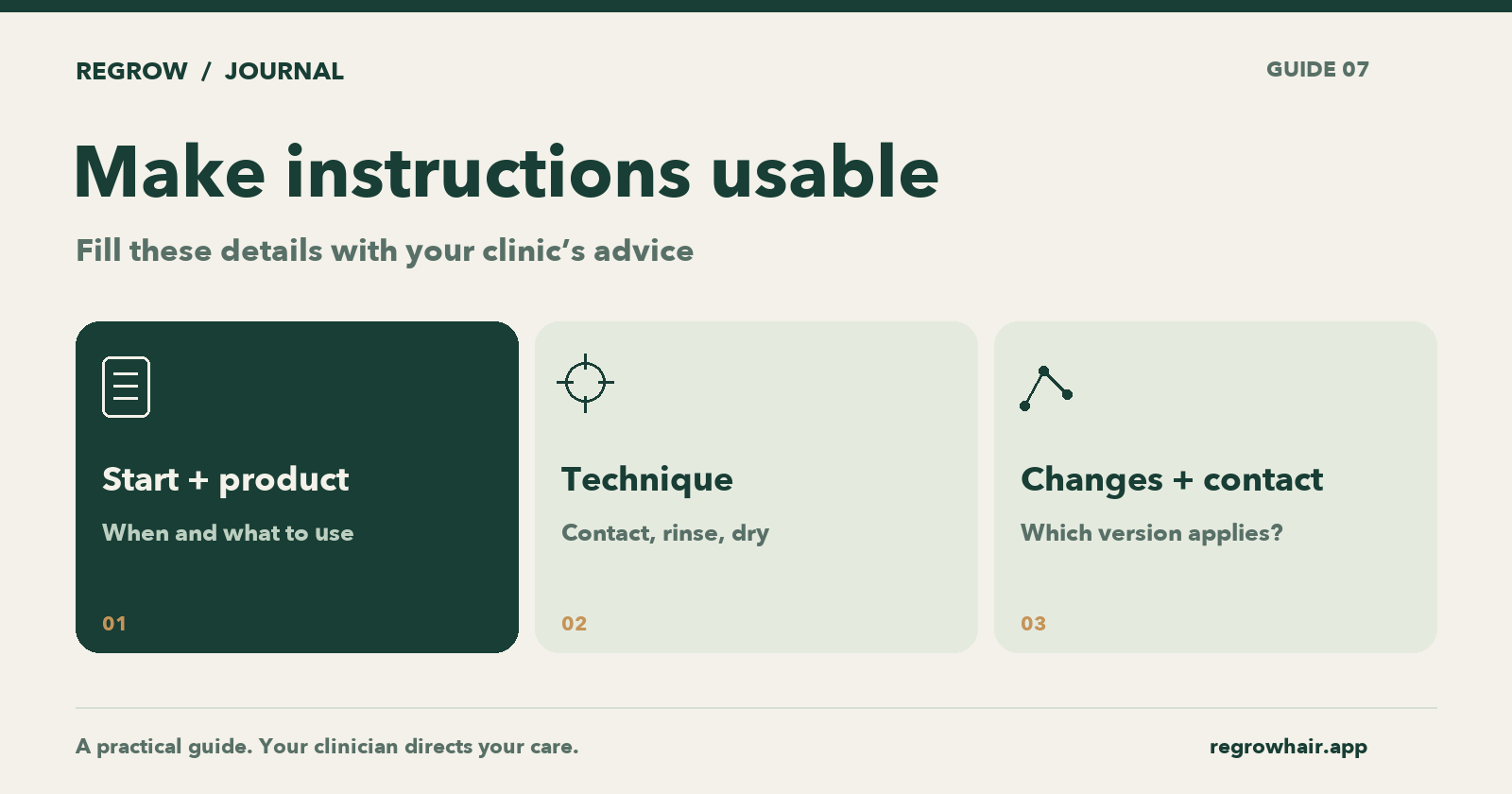
Original Regrow editorial diagram. All meaningful guidance is also available in the article text.
“When can I wash my hair?” sounds like one question, but it usually contains several: when to start, which product to use, how to apply it, how to rinse and what to do if something feels wrong. A single day number from a search result cannot answer all of them for your procedure.
The NHS says your surgeon should explain how to look after the transplant. Use the clinic’s personalised instructions as your starting point. NHS: hair transplant recovery.
Ask for a demonstration you can repeat back
Before leaving, ask the clinic to demonstrate the permitted technique and identify the exact product it wants you to use. Then explain the steps back in your own words. If you are unsure about one action, ask while the person giving the instructions is still available.
Request a written version or the clinic’s own approved demonstration link. If you are given a video, record which part applies to your current stage. A long playlist is less useful than a clear instruction you can find when needed.
Capture six details in one note
Use these headings for the clinician’s answers:
Start: the date or condition for beginning, as instructed.
Product: exact name and any alternatives the clinic permits.
Contact: what you may touch and the technique demonstrated.
Rinse: how the clinic wants you to rinse.
Dry: the permitted drying method.
Change or concern: when instructions change and whom to contact.
This is an original note-taking template. It deliberately leaves the clinical answers blank. Do not fill them with a stranger’s schedule or assume an unlabeled bottle is equivalent to the prescribed product.
Resolve conflicting instructions before improvising
Suppose a printed sheet and a later message seem inconsistent. Send both back to the clinic and ask: “Which instruction applies to me now, and does this replace the earlier one?” Keep the clarification with the sheet.
If someone says “wash normally,” ask what that means in practical terms. Your normal routine may include actions the clinician has not considered, such as a particular shower setting, styling product or towel technique.
Prepare the space around the instructions
Once you know the permitted routine, put the approved supplies together and keep the instructions readable nearby. If you need assistance, have the helper hear or read the same guidance. Avoid relying on memory while trying to manage several unfamiliar steps.
You can make a simple record: date, routine completed as instructed, and any question to raise. Do not turn the log into a test of how quickly you can progress to the next stage.
If you cannot follow a step, ask for an alternative
Limited mobility, travel accommodation or missing supplies can make a prescribed routine difficult. Explain the actual obstacle to the clinic instead of quietly substituting another method. “I cannot manage this movement safely” is a useful care question.
If you experience a concerning or unexpected symptom, contact your treating team; use urgent medical services when appropriate. Do not wait to finish washing or take a perfect photograph before seeking needed help.
Keep the latest version easy to find
Save the current instructions somewhere distinct from research screenshots and old proposals. Label them with the clinic and date. The helpful reminder is “check the current clinic instructions,” not an invented universal washing schedule.
Download Regrow to keep clinic information with your recovery record. Core features are free, and your clinician’s directions always take priority over general app education.
Published by Regrow. AI-assisted research and writing; not clinically reviewed. This is an instruction-organising guide, not a washing protocol.
- Aftercare
- Hair transplant
Regrow provides general education and self-tracking. It is not a medical device and does not provide diagnosis, treatment or medical advice. This article has not been reviewed by a clinician. Your clinic's instructions always come first.