


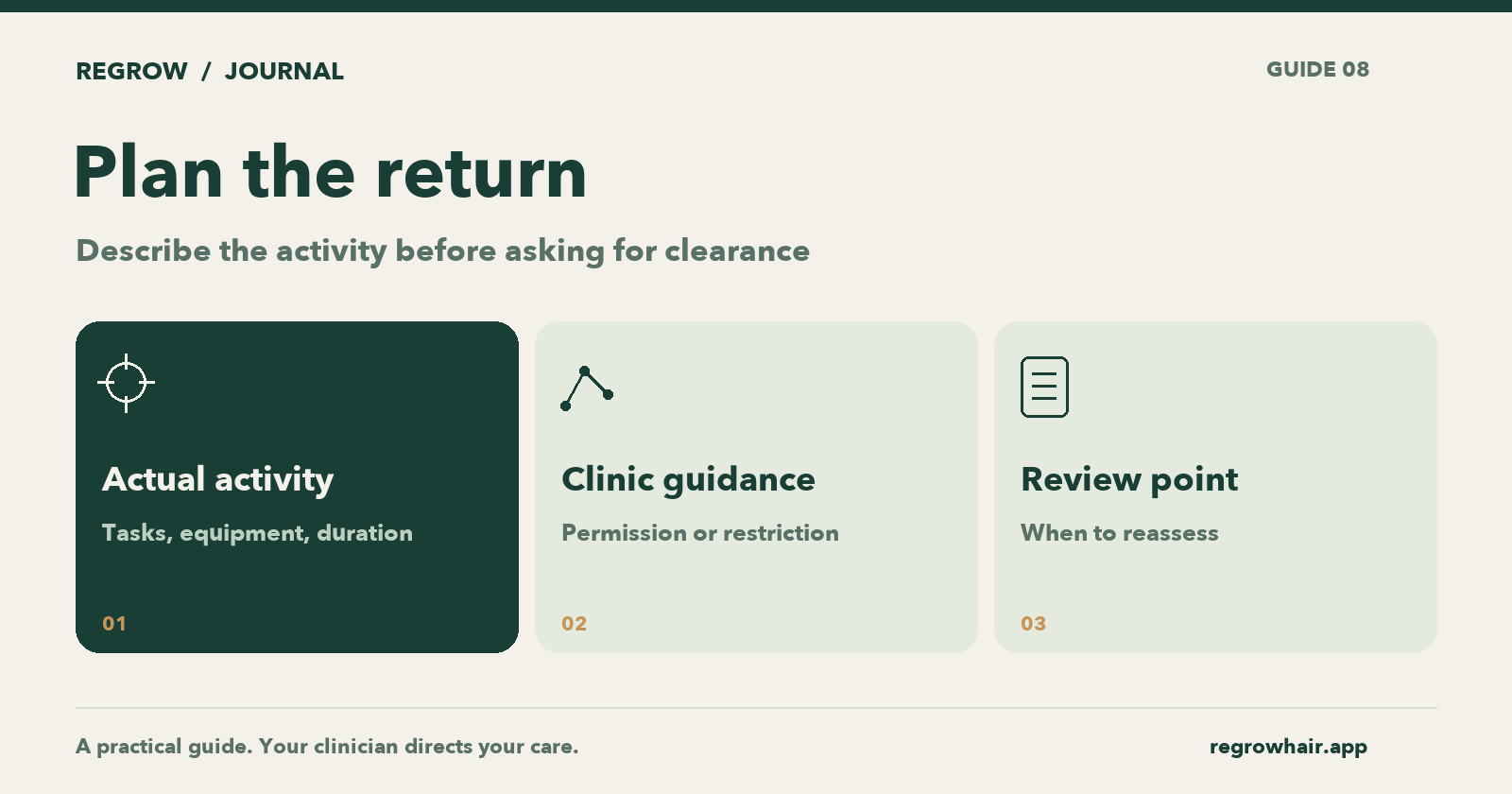
Original Regrow editorial diagram. All meaningful guidance is also available in the article text.
Returning to a desk, lifting equipment and playing a contact sport are different activities. Asking only “When can I go back to normal?” makes it difficult for your clinic to give useful guidance. Describe what your normal week actually involves.
The NHS notes that time off work and temporary exercise restrictions may be needed after a hair transplant. Your own return plan should come from your treating team. NHS: recovery after hair transplantation.
Make an activity list before requesting clearance
Write down a typical workday and training week. Include the parts you might otherwise forget: commuting, carrying a laptop bag, lifting boxes, wearing head protection, outdoor work, swimming or contact with equipment.
For each activity, record three separate things: what it involves, what the clinic allows, and when to review the restriction. Leave the permission column blank until you have an answer. A blank is safer than interpreting silence as clearance.
Describe the task instead of its label
“Gym” could mean a short walk or heavy lifting. “Office work” could include a long commute and a required helmet. Give concrete details without deciding for yourself which ones matter clinically.
A useful question is: “My work requires [specific tasks] for [duration], with [equipment or exposure]. What should I avoid, what can I modify, and when should we review that?”
For training, describe the actual session you hope to do. Ask whether the answer changes for different activities rather than applying permission for one activity to everything else.
Agree on a practical work arrangement
Once you have medical guidance, identify what can be changed at work: location, duties, hours or timing. Ask your employer what documentation it needs. Requirements differ by workplace and jurisdiction, so do not assume a blog can establish your leave entitlement.
You can communicate a temporary limitation without providing your manager with your entire medical history. Share the information needed to arrange the work safely and use the appropriate workplace process.
Put the review point in the calendar
Record who gave the advice and when. If clearance depends on a follow-up assessment, set a reminder for the assessment rather than a reminder that says “restriction ends.” Those are not the same event.
If an appointment moves, revisit any plans that depended on it. A delayed check-up should not silently become approval because the original date has passed.
Have a plan for a task you cannot postpone
If a work requirement conflicts with the instructions, contact the clinic early and explain the constraint. Ask your workplace about alternatives. Do not rely on a different patient’s social-media return date to settle the conflict.
If an activity produces an unexpected or concerning change, stop relying on a general timeline and seek appropriate clinical advice. Medical emergencies need local emergency care, not an app notification.
Use a record that helps you act
Your finished return plan should fit on one page: activity, restriction or permission, modification, review date and contact. You do not need an elaborate productivity system. You need the correct answer available when someone asks you to do something.
Download Regrow to keep recovery dates and clinic information accessible. Regrow supports organisation and general education; it does not clear you for exercise or work.
Published by Regrow. AI-assisted research and writing; not clinically reviewed. This is a planning worksheet, not a return-to-work or exercise prescription.
- Aftercare
- Hair transplant
Regrow provides general education and self-tracking. It is not a medical device and does not provide diagnosis, treatment or medical advice. This article has not been reviewed by a clinician. Your clinic's instructions always come first.